Fundeun awards 15 innovative projects in health, AI and biotechnology in Alicante
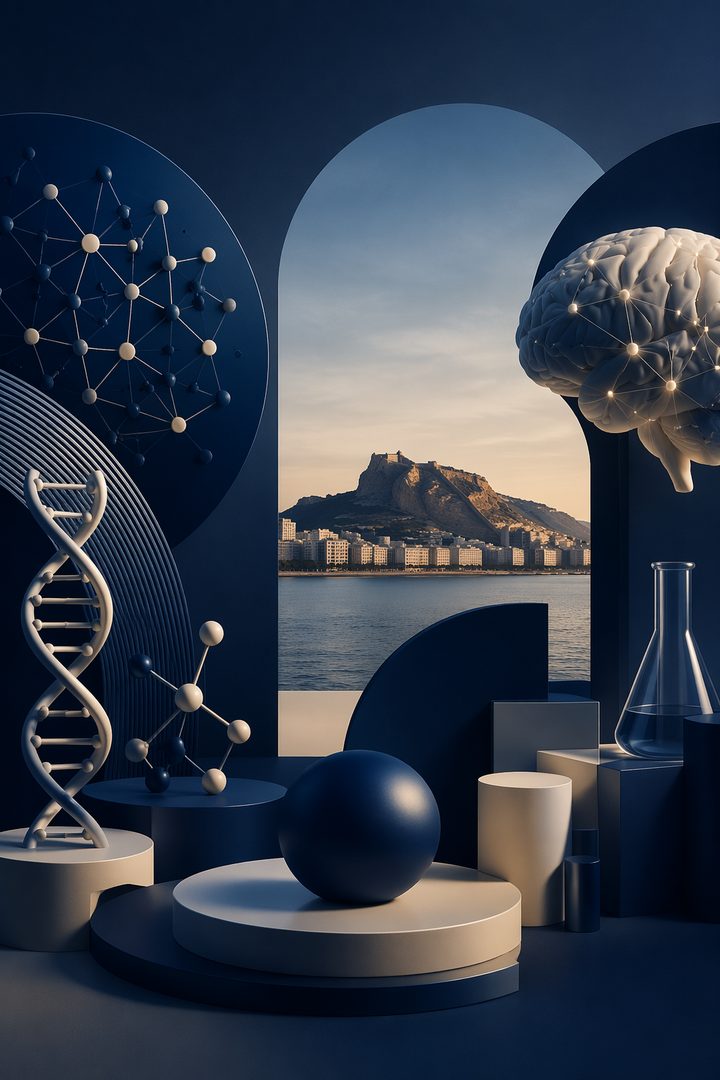
The Alicante University-Business Foundation presents its New Business Ideas Awards in their 32nd edition. Among the 15 winners —chosen from 85 applications— standout projects include AI for social work, reef monitoring and data sovereignty.
By Información (Alicante) · June 26, 2026.
The Fundación Empresa Universidad de Alicante (Fundeun) held the 32nd edition of its New Business Ideas Awards this Friday at Alicante's Santa Bárbara Castle. Of the 85 entries submitted, the jury selected 50 finalists and ultimately granted 15 awards across various categories, with cash prizes of up to 4,500 euros per project. Participants received specialized mentoring from Fundeun, Alicante Emprende and the CEEI of Elche to turn their ideas into viable business plans.
In addition to the project awards, the gala recognized the foundation's former president and CEO of Maisa, Antonio Fernández Gómez, with the Business Knowledge distinction, granted unanimously by the board to individuals who have helped strengthen the ties between university knowledge and the business community. The award was presented by Fundeun's current president, Carmen Berbegal, and the vice-rector of the University of Alicante, María Jesús Pastor Llorca.
**The projects most relevant to agentic AI**
Three of the 15 award-winning projects connect directly with the artificial intelligence ecosystem:
— **Atis** (Faculty of Philosophy and Letters Award), by Cristian Fernández Arnal, Adrián Fernández Arnal and Hugo Fernández Fernández, is an AI assistant specialized in Social Work, trained on the sector's regulations and technical documentation to support professionals in their daily activity. It is the prototype closest to a domain-specific vertical agent among all the winners.
— **Reef AI** (TM Grupo Inmobiliario Award), led by Javier del Portillo Fernández, Lucía Morales Sancha and Ignacio Fabbian, uses artificial intelligence and citizen science to monitor the condition of coral reefs through images captured by recreational divers. It represents an application of AI for distributed environmental analysis.
— **NeuroBlock** (Sánchez Butrón Abogados Award), by Darío Sansano Larrea, Carlos Luis Micó Giner and Carlos Rocamora Esteban, allows companies and organizations to create, train and deploy their own AI models while guaranteeing privacy, control and sovereignty over their data. This project points directly to the on-premise AI segment and private models that avoid dependence on large cloud platforms, a growing trend in the European business market.
— **TuyTu** (Provincial Council of Alicante Award), by Amir Es Sabbany Saber, develops cybersecurity solutions to protect personal images from the misuse of AI, making it harder to generate deepfakes and other manipulated content. Although not an AI agent in itself, it responds directly to the consequences of generative systems.
**The rest of the award-winning ecosystem: health, biotech and agri-tech**
The other projects show the diversity of sectors covered by the competition:
— **LacriDx**, by Ceren Sahin, proposes an early-diagnosis platform based on biomarkers present in tears to detect diseases such as diabetes or Parkinson's non-invasively. It is one of the projects with the greatest translational potential in early medical diagnosis.
— **L-Track**, by Lidia del Campo Benmansour, Isabel Moll Pombo and Lucía Moreno Sarría, develops a rapid test based on CRISPR technology to detect Listeria monocytogenes in under two hours, improving food safety.
— **Zenithia**, by Lidia Fructuoso, Andrea González Fernández and Carmen Fernández Torregrosa, proposes bactericidal surfaces and coatings for hospitals, healthcare centers and care homes. This project also received the AEPA Award for the best project led primarily by women.
— **Dialiseps**, by Óscar Reig Pardo, Jorge Raboso Briones and Donis Albeldo Soriano, presents a sustainable biotechnological technology to remove heavy metals from wastewater and promote the reuse of reclaimed water.
— **MoveLight**, by Alberto Ferriz Valero, Salvador Baena Morales and Francisco Javier Sainz Muñoz, is a smart belt that monitors and visualizes in real time the intensity of physical effort during sports practice.
— **PharmEutectics**, by Gabriela Guillena Townley, Maria Luisa Di Gioia and Alejandro Cores Rodríguez, bets on pharmaceutical processes based on green chemistry to reduce waste and improve industrial sustainability.
In the agri-tech field: **Agrisombra** combines solar energy, vertical farming and hydroponics; **Greenpact** transforms tomato waste into functional antimicrobial ingredients; **Charoil** combines biochar and essential oils for fertilization and pest control; and **ChitoCarbs** develops biostimulants from chitosan obtained from shellfish industry waste.
**Context and relevance for agentic AI**
As sector context, the proliferation of domain-specific vertical assistants —such as Atis for social work— reflects a consolidated trend in the European market: against the generalist models of the large providers, agents trained on sector-specific documentation offer greater precision and regulatory compliance in regulated environments such as healthcare or social services.
Likewise, the interest in projects like NeuroBlock (private deployment of AI models with data sovereignty) fits within the requirements of the European AI Act and the growing debate over technological dependence on U.S. cloud providers. For Spanish SMEs and public organizations, having tools that allow them to train and manage their own models without ceding data to third parties is increasingly a regulatory and strategic priority.
In this sense, Fundeun's competition acts as a barometer of the state of emerging innovation in the region: the presence of three projects directly linked to AI —and several others that incorporate it as a technical component— in a competition of local university scope suggests that the adoption of AI tools among trainee entrepreneurs has taken a qualitative leap compared to previous editions.