Aetrex uses AI to democratize its foot-health technology: from elite athletes to in-store consumers
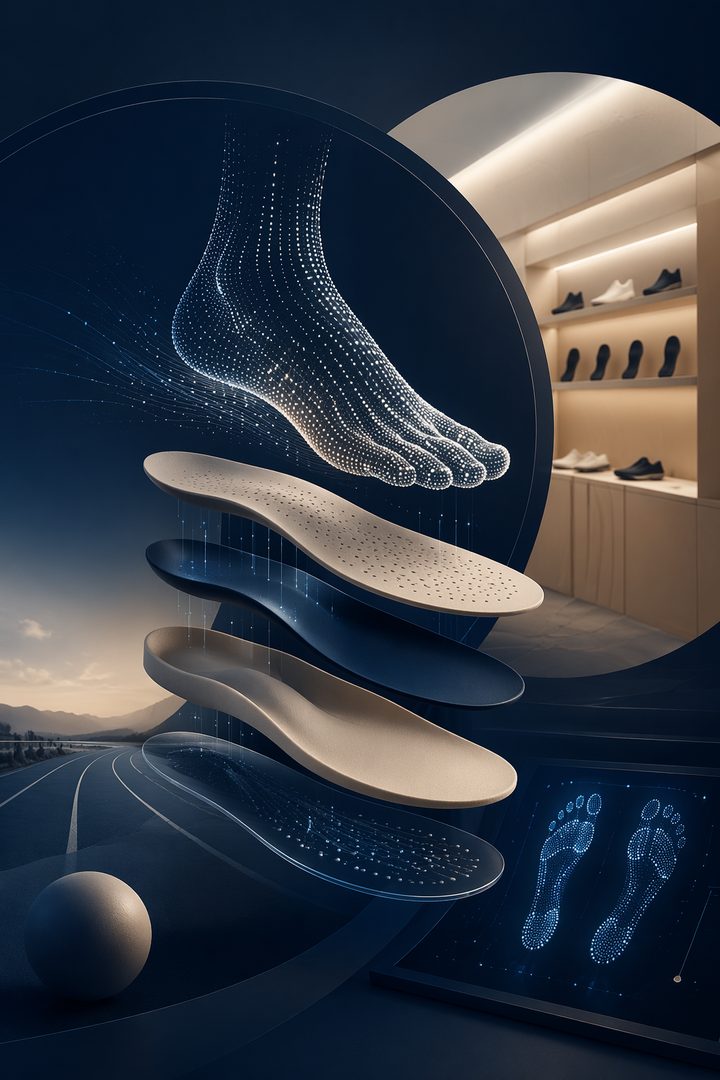
Aetrex launches the AI-powered Zoe Pro scanner at $1,995 to bring 3D foot analysis to more retailers. With 50 million scans accumulated since 2002, the company powers personalized footwear recommendations and expands its partnerships toward the Special Olympics and IMG Academy.
By WWD · June 26, 2026.
Aetrex, the world leader in foot-scanning technology, has unveiled the Zoe Pro, its next-generation 3D scanner designed to democratize access to a complete foot-health analysis at the point of sale. The launch is part of the company's strategy of combining affordable hardware with artificial intelligence software to offer personalized footwear recommendations to both everyday consumers and high-performance athletes.
**The Zoe Pro: accessibility without sacrificing precision**
The Zoe Pro inherits the essential capabilities of its predecessor, the Albert Pro —the company's flagship model—, though its price of $1,995 places it $1,000 below the Albert Pro, which costs $2,995. This price adjustment is deliberate: the goal is for more retailers to be able to adopt it without the investment being prohibitive. The scanner retains the 16 key 3D foot measurements, plantar pressure analysis and, as a differentiating new feature, it incorporates the Fit AI software preinstalled, which generates lists of footwear models available in the store where the device is installed.
In addition, Zoe includes an AI assistant that allows shoppers to interact by voice or text to find the right footwear, functioning in practice as a virtual sales associate. Integration with Heeluxe —a system specialized in footwear testing— allows the biomechanical data of each shoe model to be incorporated into the system. If Heeluxe does not have the data for a specific item, the manufacturer itself can provide the dimensions for its inclusion.
**Distribution network and retail partners**
Aetrex currently has more than 12,000 scanners installed in stores around the world. Among the retailers that already use the scanning technology and have activated Fit AI for their customers are DSW, Puma, Foot Locker, Sheels, Schuler Shoes and Nordstrom, according to the company's CEO, Larry Schwartz. The scale of this network positions Aetrex as a de facto provider of foot-data infrastructure for the global footwear industry.
The historical accumulation of more than 50 million unique scans since 2002 constitutes one of the company's most valuable assets: a corpus of biomechanical data that feeds the AI models to generate increasingly precise recommendations. The larger the database, the more refined the personalization, which creates a network effect difficult for potential competitors to replicate.
**Applications in elite sport and communities with special needs**
In April 2026, Aetrex partnered with Tradehome Shoes to bring foot-health screenings to the athletes participating in the Special Olympics USA Games, held from June 20 to 26, 2026 at the University of Minnesota and the National Sport Center in Blaine. The initiative consisted of installing 12 Albert Pro 3D scanners in the Athletes' Village and giving each athlete a free pair of Aetrex Speed orthotics to improve their biomechanical alignment, reduce fatigue and prevent injuries.
This same month of June 2026, Aetrex closed an agreement with IMG Academy —the world's leading sports-education brand, located in Bradenton, Florida— to install five Albert Pro scanners on its campus. The 1,800 student athletes who enroll each year will receive an onboarding scan covering foot-arch type, pressure distribution, 16 3D measurements and gait patterns. Each athlete will also obtain a pair of Aetrex athletic insoles and, through the Fit AI system, will receive a personalized recommendation for the appropriate athletic footwear.
**AI as a strategic development axis**
Schwartz was explicit in outlining the company's technology road map. As for hardware, he indicated that a new scanner is not expected until sometime in 2027, so the short-term focus is on software evolution. "We're working a lot on advancing AI and the AI assistant," the CEO declared, who also confirmed that a new mobile app is in the process of an imminent launch.
The bet on the mobile channel is significant: if Aetrex manages to bring part of its foot-analysis technology to a smartphone, the potential for scale multiplies exponentially, overcoming the physical limitations of in-store scanners. Although the article does not detail the app's exact capabilities, the parallel mention of work on the mobile side suggests that scanning via the phone's camera could be explored, a trend already present in other footwear-fitting platforms.
**Data as a competitive advantage: Foot.com and footwear design**
Beyond recommendations to the end consumer, Aetrex has built an additional value layer aimed at footwear manufacturers through its Foot.com portal, a research site where brands can access statistical data on foot morphology. According to Schwartz, this makes it possible, for example, to identify the most common women's size 7 in terms of shape and width, and to design lasts optimized for the majority of the population.
This use of data in the design process is perhaps the most sophisticated application of artificial intelligence in the Aetrex ecosystem: it is not just about recommending existing footwear, but about informing what footwear should exist. Brands that access these insights could develop products with greater market accuracy from the outset, reducing waste and improving customer satisfaction.
**Implications for agentic AI in health and retail**
The Aetrex case illustrates an emerging pattern in AI applied to health retail: the combination of specialized data-capture hardware, AI models trained on proprietary corpora, and a conversational assistant that acts as an autonomous agent at the point of sale. The AI assistant integrated into Zoe Pro —able to respond by voice or text and guide the purchase decision— is functionally a vertical AI agent, specialized in a specific task (finding the right footwear) with access to structured inventory and biomechanical data.
This model of an agent at the physical point of sale has broader implications: as scanners and sensors become cheaper and AI software becomes more accessible, we can expect to see similar assistants in other domains of preventive health in retail environments, from postural analysis to the measurement of basic vital signs.
**Risks and considerations**
Aetrex's business model depends largely on adoption by retailers and on footwear manufacturers' willingness to share the technical data of their products. The quality of Fit AI's recommendations is directly conditioned by the comprehensiveness of the footwear database available in each store. In establishments with limited catalogs or brands that have not shared their data, the system's usefulness may be limited.
In addition, the accumulation of biomechanical data from 50 million people raises questions about data privacy and ownership that the article does not address. In a regulatory context such as Europe's, under the umbrella of the AI Act and the GDPR, the processing of health data —which, in a broad sense, is what plantar-pressure and foot-morphology data are— requires specific controls.
**Market outlook**
As sector context, the global market for footwear-analysis and personalized-fitting technology is experiencing growth driven by the convergence of generative AI, low-cost sensors and growing consumer awareness of musculoskeletal health. Competitors such as Volumental, with its 3D foot-scanning technology, or initiatives from major platforms like Amazon with its Foot-ID, are also targeting this space, although Aetrex maintains a historical advantage in terms of installed base and accumulated data.
The decision to cut the price of the new scanner by a third relative to the premium model is a signal that Aetrex wants to gain market share in the mid-tier retail segment, where investment in technology has lower approval thresholds. If the $1,995 price proves sufficiently competitive, the scanner network could grow significantly over the next two to three years, further expanding the database that feeds its AI models.