The A-29 Super Tucano 'Gunslinger': AI to hunt drone swarms at low cost
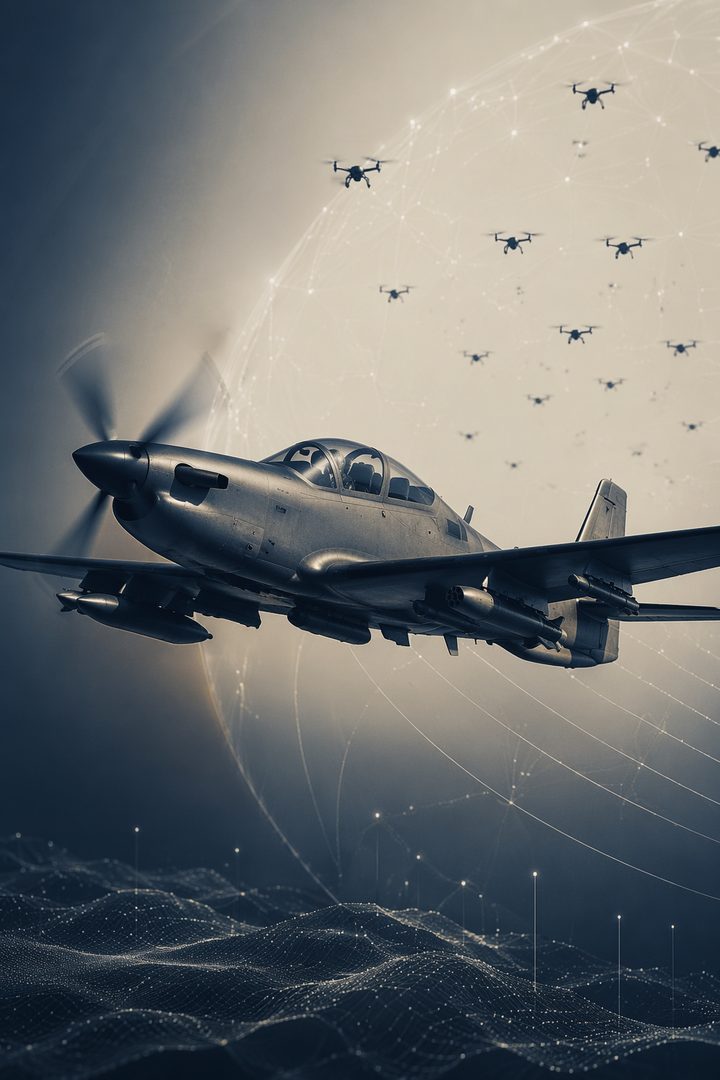
U.S. company Valkyrie Aero presents 'Gunslinger,' an AI agent integrated into Embraer's A-29 Super Tucano to neutralize drone swarms. The proposal seeks to close the gap between $20,000 threats and missiles costing more than a million.
By Pucará Defensa · June 26, 2026.
The US company Valkyrie Aero has publicly unveiled a proposal that combines artificial intelligence with a combat-proven light attack platform —the Embraer A-29 Super Tucano— to address one of the most pressing challenges in contemporary defense: swarms of small, slow and cheap drones that are nearly impossible to neutralize cost-effectively with conventional military assets.
**The problem: the economic asymmetry of drones**
The article by Joao Paulo Zeitoun Moralez in Pucará Defensa accurately describes the paradox facing modern armed forces. A commercial or militarized drone can cost as little as $20,000, be made of plastic or even cardboard, be launched from anywhere by poorly trained operators, and yet be capable of causing hundreds of millions of dollars in damage to critical infrastructure: power grids, ports, airports, command and control centers, or communications facilities.
Against that threat, the tools available in air force inventories do not fit: long-range guided missiles (BVR, beyond visual range) cost between $800,000 and more than $1.1 million per unit, a figure that in some cases has nearly doubled due to rising demand. Fighters such as the F-16 or the Eurofighter Typhoon have a cost per flight hour that can exceed twice the value of the drone to be neutralized. On top of that, their advanced radars struggle to distinguish a small UAV from the background clutter of terrain, birds or clouds, a problem that only worsens in the grinding, continuous anti-swarm operation.
**Valkyrie's proposal: the 'Gunslinger' AI agent**
Valkyrie Aero is not a tech startup newly arrived in the defense sector. The company has direct experience operating fleets of the Embraer A-27 Tucano in pilot training programs and advanced air controller training (JTAC, Joint Terminal Attack Controllers) for the United States Air Force, the Navy and NATO. That proximity to front-line operators, during real exercises, allowed them to identify the operational gap they are now trying to fill.
Their answer is an artificial intelligence agent called Gunslinger, designed to execute what in NATO terminology is known as the «Find, Fix and Finish» kill chain, autonomously integrating the sensors already installed on the aircraft. The system does not require entirely new hardware on the airframe; it works with the A-29's existing electro-optical systems and presents the processed information on the rear cockpit displays, where a dedicated sensor operator manages target detection and engagement, easing the pilot's cognitive load.
The operational flow described in the article is as follows: ground-based detection systems identify the swarm's approach direction and vector the A-29 toward it. Once airborne, the aircraft's electro-optical system scans the sky to locate the threat, completing the «Find» phase. The Gunslinger agent calculates in real time the best route, attack geometry and intercept profile —the «Fix» phase—, and presents this information to the pilot so they can select the most suitable weapon. The final «Finish» phase is carried out using the two .50 caliber machine guns mounted on the wings or laser-guided rocket launchers mounted on the external pylons.
**The platform: the A-29 Super Tucano as the base**
Valkyrie chose to partner with Embraer to bring the Gunslinger to the A-29 Super Tucano, a single-engine turboprop of which more than 300 units have been sold to operators on every continent, with more than 25 years of service and tens of thousands of hours of real combat flight. This is not an experimental aircraft, but a combat-proven platform with decades of operational service.
From its original design, the aircraft was conceived to operate from airfields with minimal infrastructure, offer great endurance and strike low-altitude, low-relative-speed targets, while keeping operating costs per flight hour far below those of any jet aircraft. Its two-seat tandem cockpit, originally intended for pilot and instructor or attack pilot, fits perfectly with Valkyrie's proposal: turning the rear seat into a sensor operator station dedicated to managing the Gunslinger.
In terms of armament, the configuration with two .50 caliber machine guns on the wings frees up the four external pylons for various combinations: two additional fuel tanks plus two laser-guided rocket launchers for long-range or low-threat missions, or four rocket launchers in a maximum firepower configuration when the area of operations is close to the base. Laser-guided rockets represent a radically lower-cost alternative to conventional guided missiles, which is precisely the economic core of the proposal.
**Implications for agentic AI in defense**
The Gunslinger case is especially relevant for those following the development of agentic AI systems, because it illustrates a clear trend: the integration of autonomous tactical decision-making agents into real physical platforms with lethal capability. The agent does not just analyze data; it calculates attack geometries, optimizes intercept profiles in real time and delivers actionable recommendations directly to the human operator. It is a closed feedback loop where the AI acts as a specialized tactical copilot.
This architecture —human in the loop, but with the computational burden delegated to the agent— is the model that most military AI programs are adopting to keep human oversight over the final decision to fire, while automating the detection, classification and intercept planning phases. It is what in the civilian sphere we might call a decision support system with semi-autonomous execution.
The article explicitly mentions that the Gunslinger uses the «systems already installed on the aircraft», which points to a software integration on top of existing hardware —a common pattern in military modernization kits— that enormously reduces the cost of adoption and certification times compared to installing entirely new sensors on the airframe.
**The threat that is not solved**
Valkyrie's diagnosis is that existing c-UAS solutions —sensors, jammers, munitions and others— have not proven effective enough in this type of warfare, especially in swarm scenarios and when drones are built from non-metallic materials.
The resort to fighters such as the F-16 and the Typhoon equipped with laser-guided rocket launchers, according to images published online referenced by the article, confirms that even the best-equipped forces are looking for improvised solutions. The existence of that gap is the premise on which Valkyrie builds its entire value proposition.
**A forward-looking vision: a return to visual combat?**
The article closes with a thought-provoking reflection: as advanced electronic warfare capabilities degrade missile guidance systems and high-threat anti-aircraft environments limit access to supersonic fighters, air combat could in some respects revert to dynamics typical of World War II, with light single-engine aircraft facing aerial vehicles at short visual distances. The decisive difference would be, precisely, the AI agent: Gunslinger would act as the element capable of making the difference between success and failure against small, multiple targets.
This perspective has broader implications for the design of future air forces: Valkyrie's proposal suggests that low-cost platforms, with onboard AI, could take on c-UAS missions more efficiently and sustainably than high-performance fighters, freeing the latter for missions where their technological superiority is irreplaceable.
**Market considerations**
As sector context, the global c-UAS systems market has grown exponentially since 2022. Manufacturers such as Rheinmetall, Rafael, Thales, L3Harris and numerous startups compete with proposals ranging from high-energy lasers to physical nets and full-spectrum jamming. Valkyrie's bet is distinctive because it does not propose a fully autonomous system or a new type of platform, but rather an AI layer on top of an aircraft already in service in dozens of the world's air forces. If the A-29 Super Tucano is already in an operator's inventory, the marginal cost of adding the Gunslinger could be considerably lower than acquiring a dedicated c-UAS system.
However, the article does not provide data on the system's price, development timeline, expected military certification, or existing or under-negotiation contracts. The proposal appears to be still in a public unveiling phase, with no formal acquisitions confirmed as of the publication date.